
Anthropic’s annualized revenue went from $1B to $9B in 2025. OpenAI just raised $110 billion from Amazon, SoftBank, and others, making it one of the largest private funding rounds ever. These are arguably two of the most important companies being built right now, but you likely don’t own a single share of them.
If you are not a venture capitalist and if you did not have the foresight, luck, social graph, or Bay Area housing-equity-derived risk tolerance to get into one of these companies early, your options are limited.
But there is, technically, a path.
The Traditional Path: SPVs
If you are an accredited investor ($200k annual income or $1M net worth excluding your house, meaning the state has decided you are rich enough to deserve access to financial products that could make you even richer) you may be able to buy exposure through an SPV, a Special Purpose Vehicle.
SPVs offer exposure to private companies, but with a hefty price tag: 5–15% upfront fees, 20% carry on profits, 30–90 day closing timelines, and 5–7 year lockups.
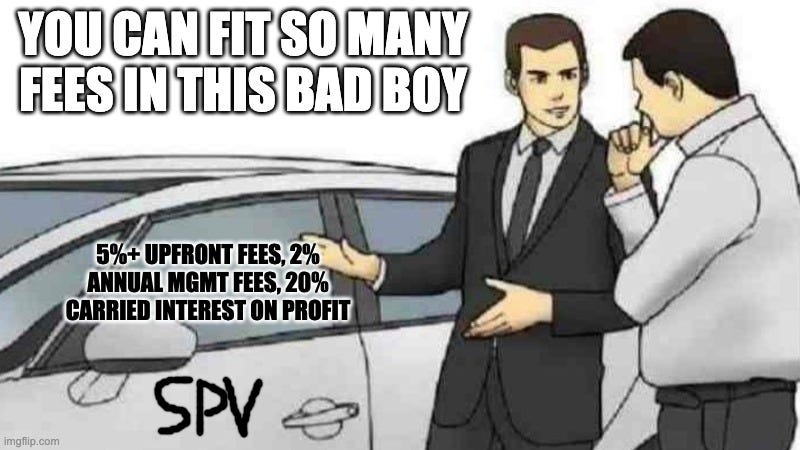
What You Actually Own
Because OpenAI tightly restricts direct and indirect transfers of its equity, and Anthropic appears to handle liquidity similarly in practice, you usually can’t just ask your friend who works there to sell you stock and put it in your name.
Instead, the workaround is an SPV: a sponsor forms a Delaware LLC, buys shares via a company-approved transaction from an employee or early investor, and sells you membership interests in the LLC.
You still don’t own Anthropic (or OpenAI) stock. You own a fraction of a legal entity that does.
The Secondary Market Reality
On secondary platforms like Forge or Hiive, buyers bid and negotiate directly with SPV share-owners. If you manage to find stock in a market as constrained as Anthropic’s, where demand has reportedly outstripped supply by roughly 36 to 1, this is only the start of the process.
Once you agree on terms, a deal can still take 30–90 days to settle while the company reviews the transfer, exercises any rights it has, or blocks the sale outright.
Deals on those platforms carry fees, too: one public Anthropic offering, for example, listed a 3% management fee paid upfront, a 5% setup fee, a 2% services fee, a 4.5% broker commission, and 15% carry. The listing showing a pre-fees valuation of $350B and a post-fees valuation of $410B.
The Other Limitation: You Can’t Short
There is another problem.
If you think OpenAI trading at $700B+ with $8B in annual cash burn and profitability projected around 2030 is crazy, you cannot do much about it. Want to go all Big Short on them and bet against the valuation? You can’t, because SPVs only let you go long.
No shorts. No hedging. No clean price discovery.
A Simpler Idea
Instead of buying the underlying shares through an elaborate wrapper, you could simply trade the valuation directly.
The MNX approach: cash-settled futures on private-company valuations.
If you are familiar with commodity futures, the analogy is straightforward:
A farmer sowing corn seeds in April can short December corn futures to hedge against falling corn prices. This effectively locks in a sale price at harvest.
Now swap corn for private-company valuations. Instead of locking in the future price of corn, you lock in the future reported valuation of OpenAI or Anthropic at the end of December this year. The contract settles to that reported valuation.
For example:
Anthropic 2025 market would have resolved to $183B
OpenAI 2025 market would have resolved to $500B
As the next year approaches, traders simply roll into the next contract.
Why This Works Better
This gets you something very close to what many people wanted from SPVs in the first place: exposure to changes in valuation.
Unlike SPVs, positions can be long and short. Unlike SPVs, markets are open 24/7. Unlike SPVs, it does not require paying enormous structuring fees to a small legal bureaucracy.
No Perps?
Traders familiar with today’s crypto markets might ask: why not use perps?
A perp or perpetual future is a derivative designed to track an asset’s price without an expiration date. Perps work best when there is an underlying reference price that is actively traded.
That is not the case for OpenAI or Anthropic.
On current venues, the “price” of these perps is often driven partly by internal trading dynamics, partly by off-chain valuation feeds, and partly by stale funding-round valuations or thin secondary data.
So instead of clean exposure to a real value, traders get exposure to a semi-fictional number whose relationship to reality is tenuous.
The Cost of That Distortion
This leads to predictable outcomes. The leading Anthropic perp has a 30-day cumulative annualized funding rate of around 65% / year.
This means that if you went long Anthropic at 1x leverage, you’d lose almost two-thirds of your money within a year if the funding rate remained at similar levels. This rate makes even bad SPVs start to look respectable.
You are paying high carrying costs for exposure to a poor pricing function with liquidation risk layered on top without even the comfort of a circuit breaker.
The Gap in the Market
In other words, SPVs are expensive, slow, and one-directional. Existing perps are fast, but not anchored to reality.
There is room in the middle for a product that is simple, cash-settled, two-sided, and tied to clear resolution criteria.
What We’re Building
We’re building a way to trade private-company valuations directly, without pretending you are buying the stock itself and without relying on a self-referential price feed.
If this sounds interesting, you can explore our testnet: https://testnet.mnx.fi
OpenAI and Anthropic valuation markets on MNX go live in a few months.